Skip to content

Process expertise. Chinese manufacturing. Global perspective.

PREASYS

Equipment & technology

Vertical Form-Fill-Seal Bagger (VFFS)

A vertical form-fill-seal bagger forms rollstock around a filling tube, receives the metered product, then seals and separates the finished bag.

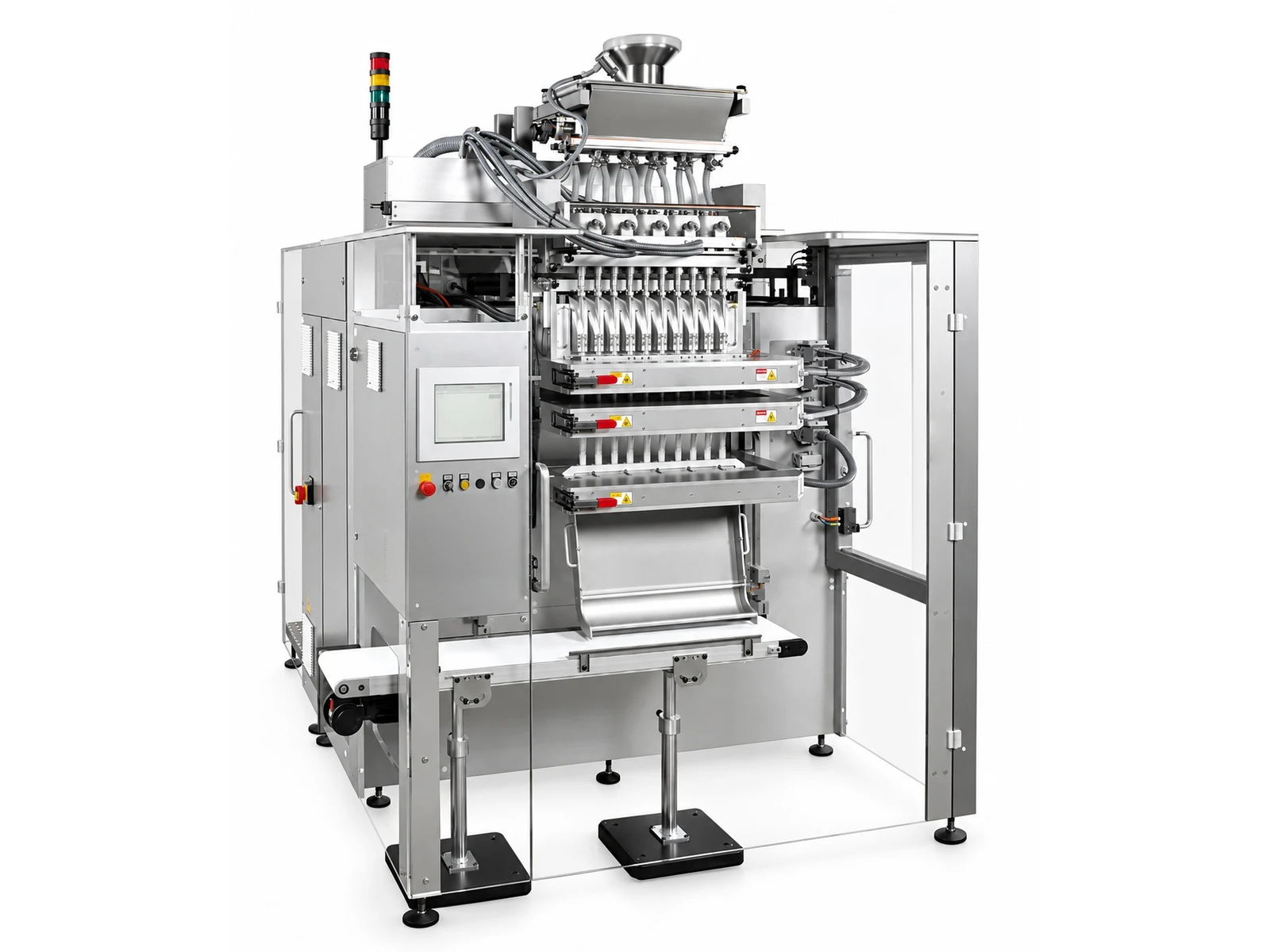
Vertical forming and sealing machine with multiple dosing lanes
Process context · Vertical forming and sealing machine with multiple dosing lanes

Vertical Form-Fill-Seal Bagger (VFFS)

Form and fill a bag around the product flow

Coordinate the web, product drop and sealing jaws

The forming set shapes the web and establishes its longitudinal seal. Product enters before the transverse sealing operation closes and separates the bag. Sticky or coated pieces can change the timing of that drop and leave material near the seal; feeder behaviour and film conditions therefore affect packaging quality together.

Formed packs on the discharge conveyor of a vertical packing machine
Process context · Formed packs on the discharge conveyor of a vertical packing machine

Process at a glance

The film sealing window and product-drop timing jointly determine the useful operating condition.

Form

Guide the selected laminate into its bag geometry

Seal

Close the package after the product clears the jaws

Filling technologies

Filling technology

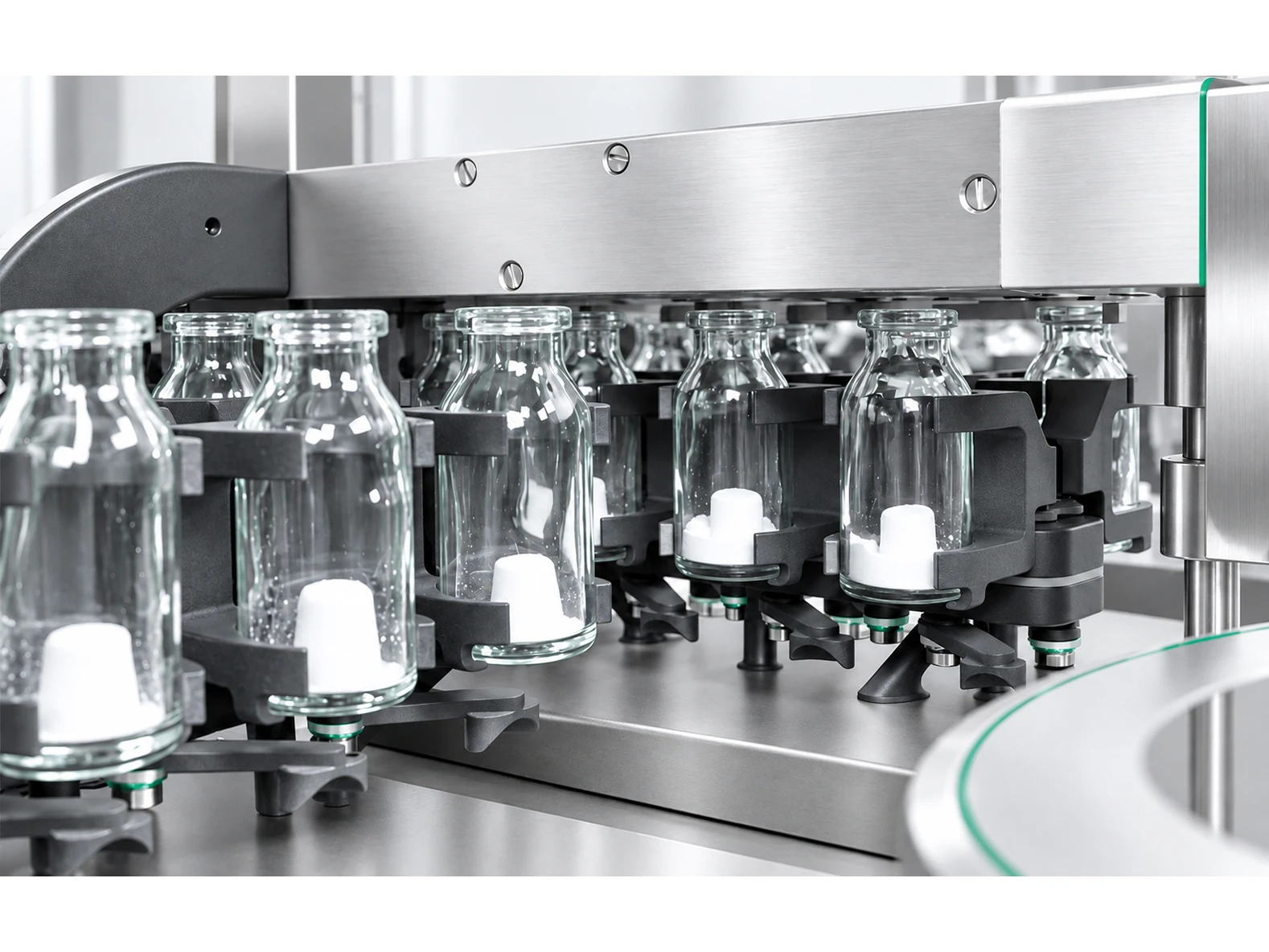
Powder dosing — a separate material application

The illustration shows powder dosing into vials, a separate application from the finished gummy pieces discussed here. Gummies require a suitable count- or weight-based feeder and a controlled drop into the bag. Auger or vacuum powder metering does not describe this piece-handling route.

Explore technology
Glass vials presented below the powder dispensing heads
Separate powder-filling illustration; not the gummy-piece feed or bagger shown by this page scope.
Technology 1 of 1

Process challenges

Sugar or oil at the sealing interface can affect bonding. Greater force cannot compensate for every contamination or material problem.

Read details

Sugar or oil at the sealing interface can affect bonding. Greater force cannot compensate for every contamination or material problem.

Bag shapes require the appropriate forming and sealing stations. A range of possible formats is not a guarantee that each is fitted to one machine.

Zipper registration must remain aligned through forming, filling and transverse closure. Finished opening function needs its own check.

Two product paths divide the feed demand and require their own timing and tracking. Floor-space assessment includes all supporting equipment.

Changing bag geometry can change tooling, film routing and feeder timing. The actual changeover scope determines its duration.

Seal integrity depends on the film, contamination and thermal-mechanical window. It is verified by the specified package tests.

Wrinkles can arise during forming or closing and disturb both the zipper and transverse seal. Samples after a stop reveal different behaviour from steady running.

Recyclability belongs to the complete packaging structure and its collection context. A paper appearance alone does not establish that claim.

Technical data & features

Film structure, seal conditions and the way the product falls into the forming tube must be selected together.

Formed packs on the discharge conveyor of a vertical packing machine

Motion and forming choices

Intermittent motion stops the web for part of the sequence; continuous motion coordinates sealing with a moving web. The useful cycle depends on the product drop and film sealing window.

A multiple-tube arrangement divides the product and web flow into separate paths. Feeder allocation, replenishment and reject tracking must support each path.

Protect the sealing interface

Bag geometry follows the forming set and installed stations. Gussets, stand-up structures or reclosure features need the corresponding material and tooling.

A zipper introduces an additional registration and joining interface. Its position must remain compatible with the transverse seals and finished opening.

Changeover follows forming parts, film path, product feed and seal settings Seal temperature, pressure and dwell work within the laminate-specific window

Evaluate the complete packaging material

Product drop height, guide surfaces and feed timing influence damage and sticking. Coatings can also transfer to the forming tube or sealing area.

The installation includes the feeder, film access, discharge and maintenance space as well as the bagger frame.

Access to the film and product paths

Process choice Pillow/gusset route Stand-up route Reclosable route Multiple-tube route
Timing variable Product drop and jaw sequence Forming and base sequence Zipper and seal registration Feed allocation to each path
Tooling boundary Selected forming set Bag-specific forming stations Zipper feed and joining stations Separate forming and sealing paths
Seal requirement Film-specific window Base and closure interfaces Zipper plus package closure Equivalent assessment for each path
Verification focus Net content and closure Shape and package integrity Opening function and seal quality Independent accepted/reject accounting
Selection input Bag drawing and laminate Finished pouch geometry Zipper and laminate combination Product feed and line balance

How it works

Evaluate product drop and bag sealing

How is seal contamination located?

Inspect the seal area before and after closing and relate residues to product drop timing. Compare feeder release, settling time and retained material on the forming path.

How is the film process window established?

Run the intended laminate at controlled temperature, pressure and dwell settings. Evaluate the specified seal and package tests rather than appearance alone.

How are sticky products trialled?

Use representative coating and surface conditions. Record feeding delays, clusters, residue and damage through the actual drop path.

How is a bag-format change verified?

Identify the forming parts, film and recipe; establish registration and product timing, then check net content, finished geometry and closure on the first accepted packs.

Line integration

Conditioned gummy pieces from molding and finishing + Selected film reel

↓

Selected vertical form-fill-seal sequence:

Form the selected bag geometry → Receive the metered product

→ Vertical filling → Longitudinal and transverse sealing; selected reclosure station if required → Bag discharge → [Metal detection optional] ↓

Finished bags → Selected collation → Cartoning or case packing

Upstream: conditioned gummy pieces from the selected molding and finishing route; product-specific weight- or count-based dosing.

Downstream: bag support, orientation and count match the selected cartoning or case-packing interface.

A robotic transfer, where selected, uses gripping and release conditions suitable for the filled flexible pack.

Specify the bagging recipe, seal settings and batch reports. Agree how changes and rejects are recorded and passed to the line controls.

Support throughout your project and production

Define the equipment scope

Film structure, seal conditions and the way the product falls into the forming tube must be selected together.

Learn more

Agree the acceptance test

Test the seal area for product contamination and check registration and discharge orientation.

Learn more

Prepare for operation

Identify the contact parts and format tooling for Vertical Form-Fill-Seal Bagger (VFFS). Agree access for cleaning, the spares to hold and the operating records the site will need.

Learn more

Knowledge hub

2 resources

Frequently asked questions

Can every bag style be made by the same machine?

No. The installed forming, gusseting, sealing and reclosure stations define the available formats. The bag drawing must be assessed against that configuration.

Does high sealing force guarantee a leak-free pack?

No. Film compatibility, dwell, temperature, wrinkles and product contamination also matter. Package integrity needs its specified test.

Is a weigher always the correct feeder?

No. Weight-based or count-based dosing is chosen from the pack requirement and product behaviour. Its delivery must clear the bagger sealing cycle.

Does paper packaging make the pack recyclable?

Not by itself. Barrier and seal layers, closures and the relevant collection system affect the complete pack assessment.

Contact

Share the product shape and surface condition, bag drawing and film specification. Include feeder requirements, accepted-pack output and the downstream grouping pattern.

Discuss your project →
Formed packs on the discharge conveyor of a vertical packing machine