
Skip to content

Process expertise. Chinese manufacturing. Global perspective.

PREASYS

Equipment & technology

True Density Analyzer

A gas-displacement density analyzer combines a measured sample mass with the volume inferred from pressure changes in calibrated chambers. It complements bulk and tapped measurements by examining a different volume, with the result depending on which pores the measurement gas can access.

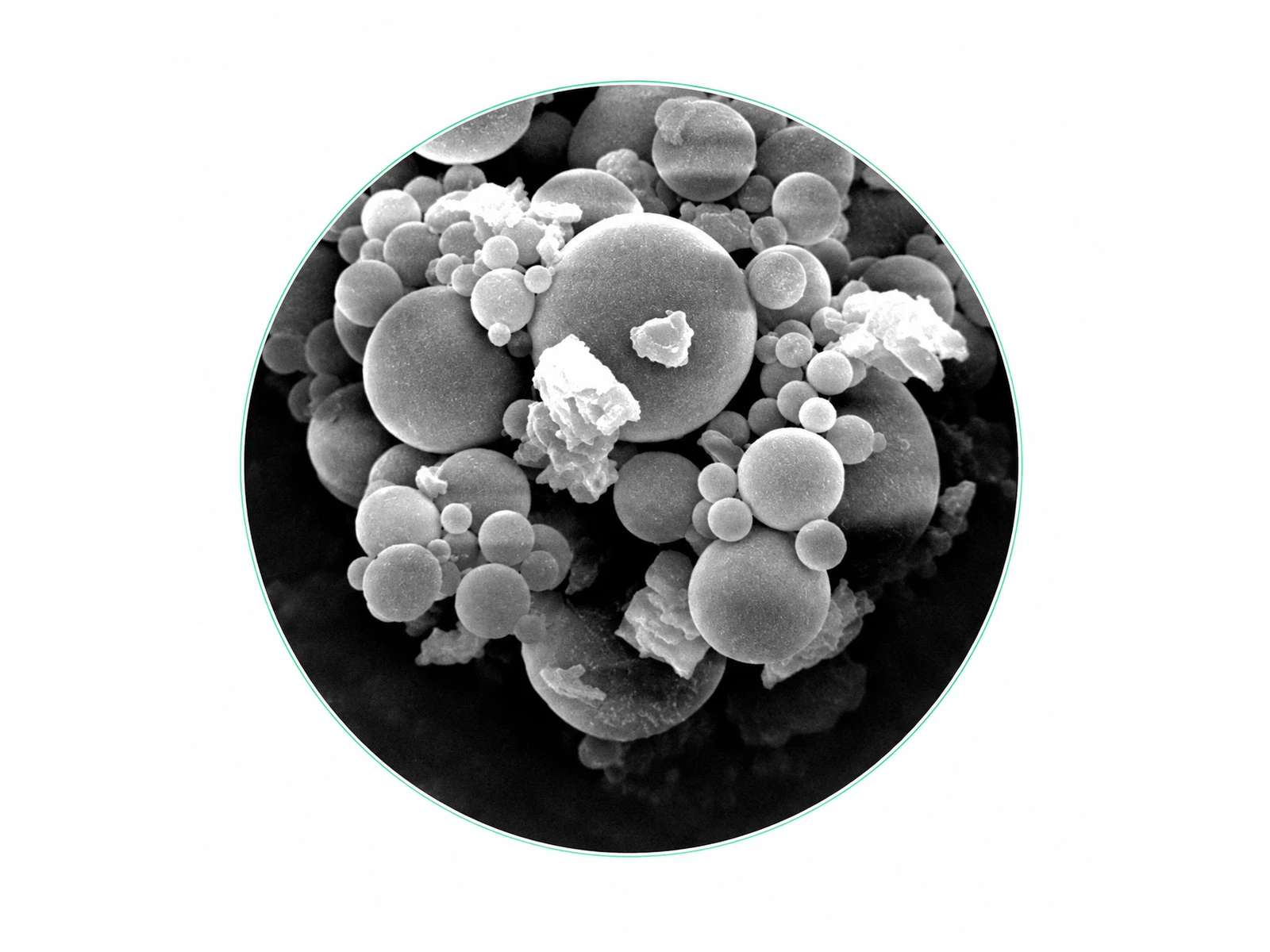
Magnified surface view of a powder particle
Process context · Magnified surface view of a powder particle

True Density Analyzer

Gas-displacement measurement of sample volume

Understand the volume behind the density value

In gas pycnometry, a sample occupies part of a calibrated chamber. Gas expansion into a reference volume produces pressure changes from which the displaced volume is calculated. Gas-accessible pores do not displace gas in the same way as closed or inaccessible pores, so the result is commonly interpreted as skeletal density under the stated conditions. Gas interaction, moisture, temperature and equilibration can affect the measurement; helium is not universally free of adsorption or interaction.

Fine green powder shown in a loose pile
Process context · Fine green powder shown in a loose pile

Example project input

Use the gas-displacement volume reported for the prepared sample. Do not substitute the powder's loose or tapped bed volume.

12 g

Dry sample mass

5 cm³

Measured displacement volume

2.4 g/cm³

Calculated sample density

Process challenges

Gas accessibility and pressure equilibration determine the volume represented by the measurement.

Read details

Pore access: the measured volume depends on the paths accessible to the gas and the equilibration conditions.

Porosity interpretation: combining density measurements requires a clear definition of the compared volumes; an interparticle void fraction is not automatically a tablet’s internal porosity.

Sample conditioning: moisture, residual solvent and insufficient equilibration can shift the pressure response and apparent volume.

Combined characterization: bulk, tapped and gas-displacement densities answer different packing and structure questions; retain their separate methods and units.

Technical data & features

Condition the sample and select measurement conditions compatible with the product's moisture and porosity.

Fine green powder shown in a loose pile

Measurement conditions and volume definition

Gas choice and equilibration influence which volume is measured and whether gas-sample interactions are significant.

Sample suitability must address gas exposure, pressure changes and conditioning; reuse cannot be assumed for every material.

Porosity or relative-density calculations need a justified reference density and a clearly defined comparison volume.

Chamber calibration, leak checks, stable temperature and repeat measurements support the volume result.

Measurement element Interpretation
Principle Infer displaced volume from pressure changes in calibrated chambers.
Measured volume Volume inaccessible to the gas under the stated measurement conditions.
Sample suitability Assess powder, granule or compact stability during conditioning and gas exposure.
Application Support material or compaction studies with clearly defined volume comparisons.
Reported result Mass, displacement volume, density and repeatability with the method conditions.

How it works

How should a sample be conditioned?

Use a procedure suitable for the material and the question being studied. Record drying or degassing conditions and the mass used; do not alter a sensitive sample merely to obtain a stable reading.

How can an unstable volume result be investigated?

Check leaks, temperature stability, equilibration and sample gas interaction. Compare repeat cycles and sample preparation before assigning the variation to porosity.

How should a porosity calculation be framed?

Define the bulk or envelope volume being compared with the gas-displacement volume. Explain whether the calculation concerns interparticle packing, compact porosity or another quantity; these are not interchangeable.

Line integration

Identified and suitably conditioned sample → Measured mass → Calibrated sample cell → Gas expansion and equilibration

→ Displacement volume → Density on the stated gas and conditioning basis

↓

Density evidence → Material or compaction study with compatible volume definitions

Support throughout your project and production

Define the equipment scope

Condition the sample and select measurement conditions compatible with the product's moisture and porosity.

Learn more

Agree the acceptance test

Distinguish the particle-density result from bulk density used for hopper and container sizing.

Learn more

Prepare for operation

Identify the contact parts and format tooling for True Density Analyzer. Agree access for cleaning, the spares to hold and the operating records the site will need.

Learn more

Knowledge hub

2 resources

Frequently asked questions

Does helium enter every pore without interaction?

No universal assumption is safe. Accessibility and equilibration depend on the pore network and conditions, and gas-sample interactions can affect some materials.

Why can this density differ from bulk density?

Bulk volume includes spaces between particles. Gas can enter accessible spaces, so the gas-displacement volume represents a different boundary.

Is the sample always reusable afterward?

Not necessarily. Conditioning, gas exposure or pressure cycling may affect a material. Confirm stability and any requirements for subsequent testing.

Does the result directly give tablet porosity?

A porosity calculation needs a compatible external or envelope volume and a justified reference volume. State the definitions and sample condition before interpreting the calculation.

Contact

Share the sample form, moisture or solvent sensitivity, expected volume and the intended density or porosity question. Identify any gas compatibility or conditioning restrictions.

Discuss your project →
Fine green powder shown in a loose pile