Skip to content

Process expertise. Chinese manufacturing. Global perspective.

PREASYS

Equipment & technology

Filling Pump

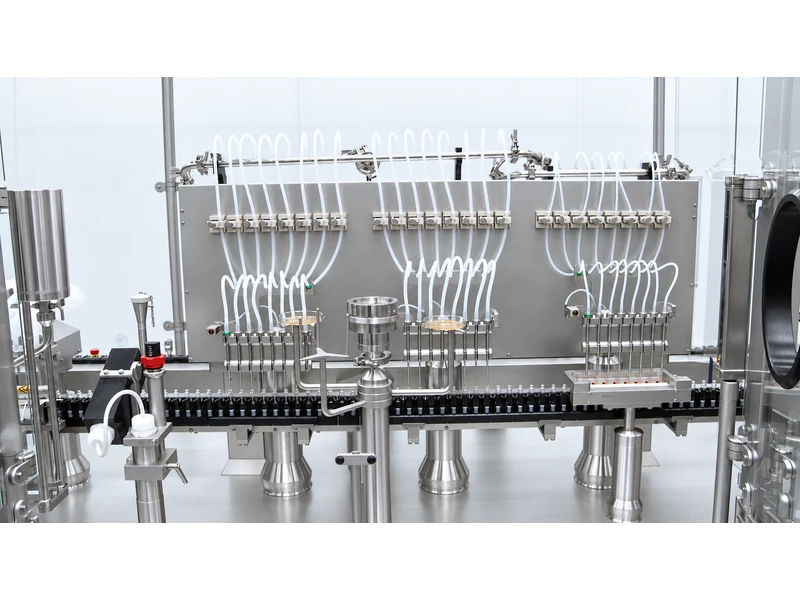
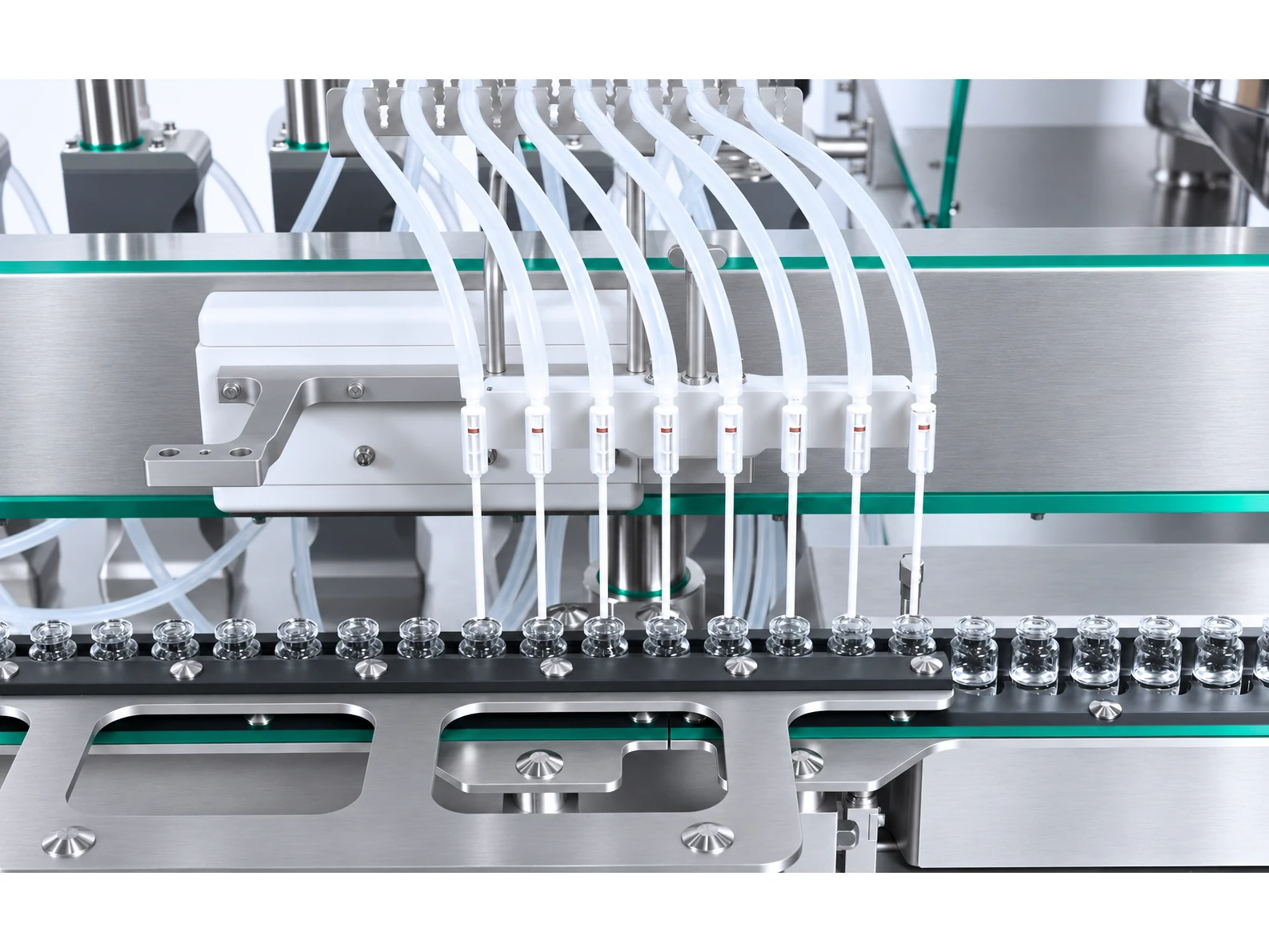
The metering system defines the product-contact path between preparation and the filling needle.

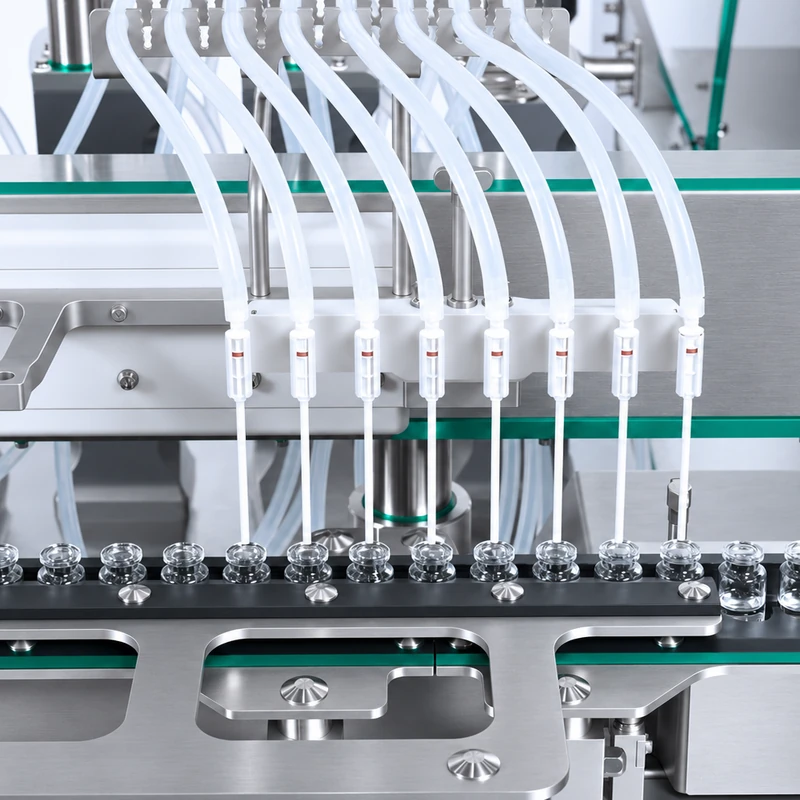
Flexible product tubes connected to a bank of filling needles

Filling Technology Overview

Diagram connecting a peristaltic pump to the product filling path

Our filling portfolio delivers precision and flexibility for biopharma. Options include peristaltic pumps for sensitive fluids, robust piston pumps for 24/7 production, time-pressure for aqueous solutions, and mass flow for high-value products. The modular Varifill platform integrates multiple technologies, while SmartFill eliminates waste across startup, running, and shutdown. This ensures high accuracy, sterility, and significant cost savings for every batch.

Example project input

Keep measurements grouped by head to reveal a drifting tube or piston. Record product temperature and the actual tubing, valve or nozzle used.

4

Filling heads

15

Dispenses weighed per head

60

Individual fill measurements

Filling technologies

Filling technology

Peristaltic pump

A flexible tube carries the liquid while rotating rollers control dosing. The product contacts the tube rather than the pump mechanism. This principle is used when a disposable product path and gentle handling are priorities. Tubing selection, product compatibility and the changeover procedure should be reviewed for each application.

Explore technology
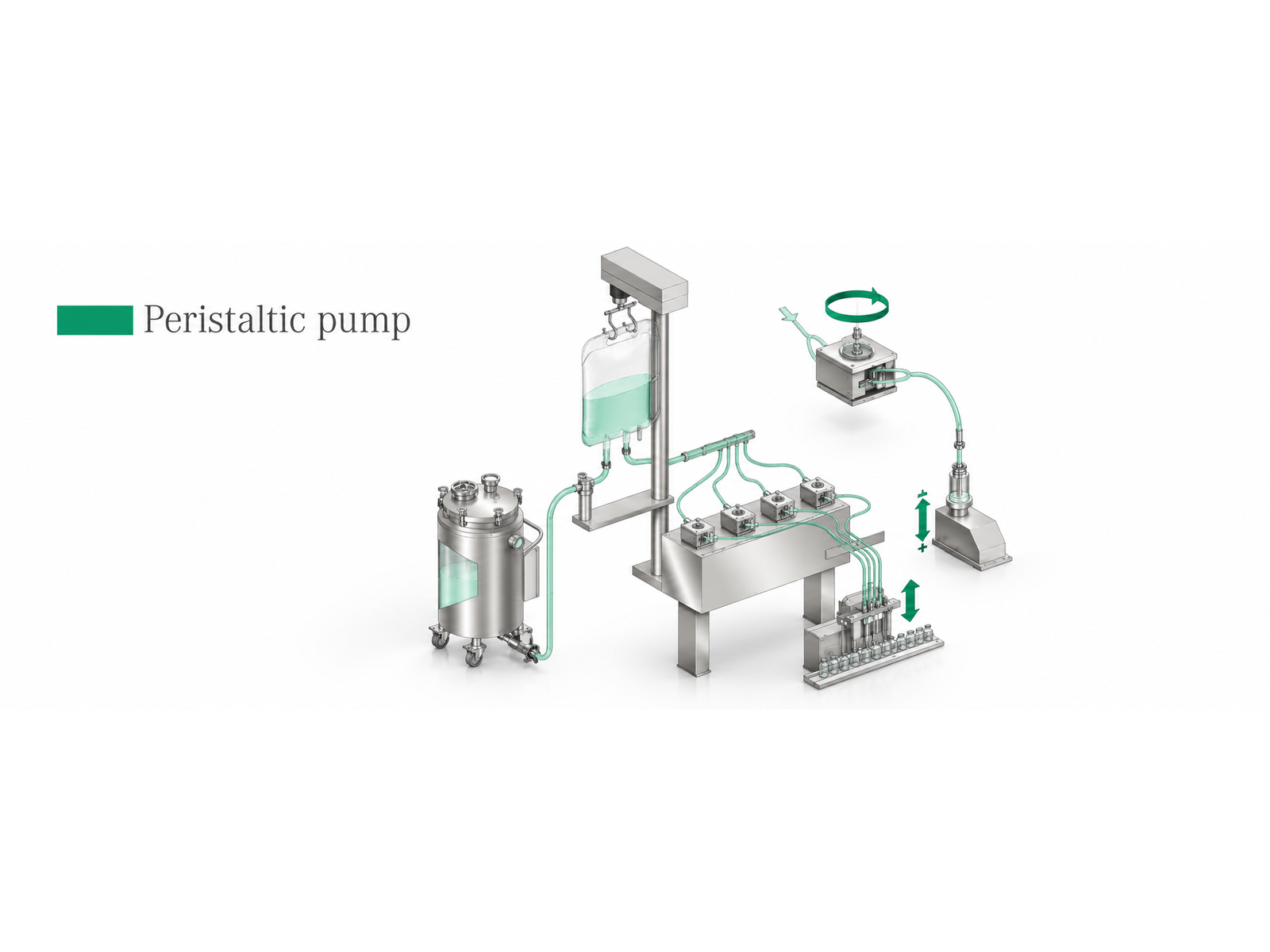
Diagram connecting a peristaltic pump to the product filling path

Filling technology

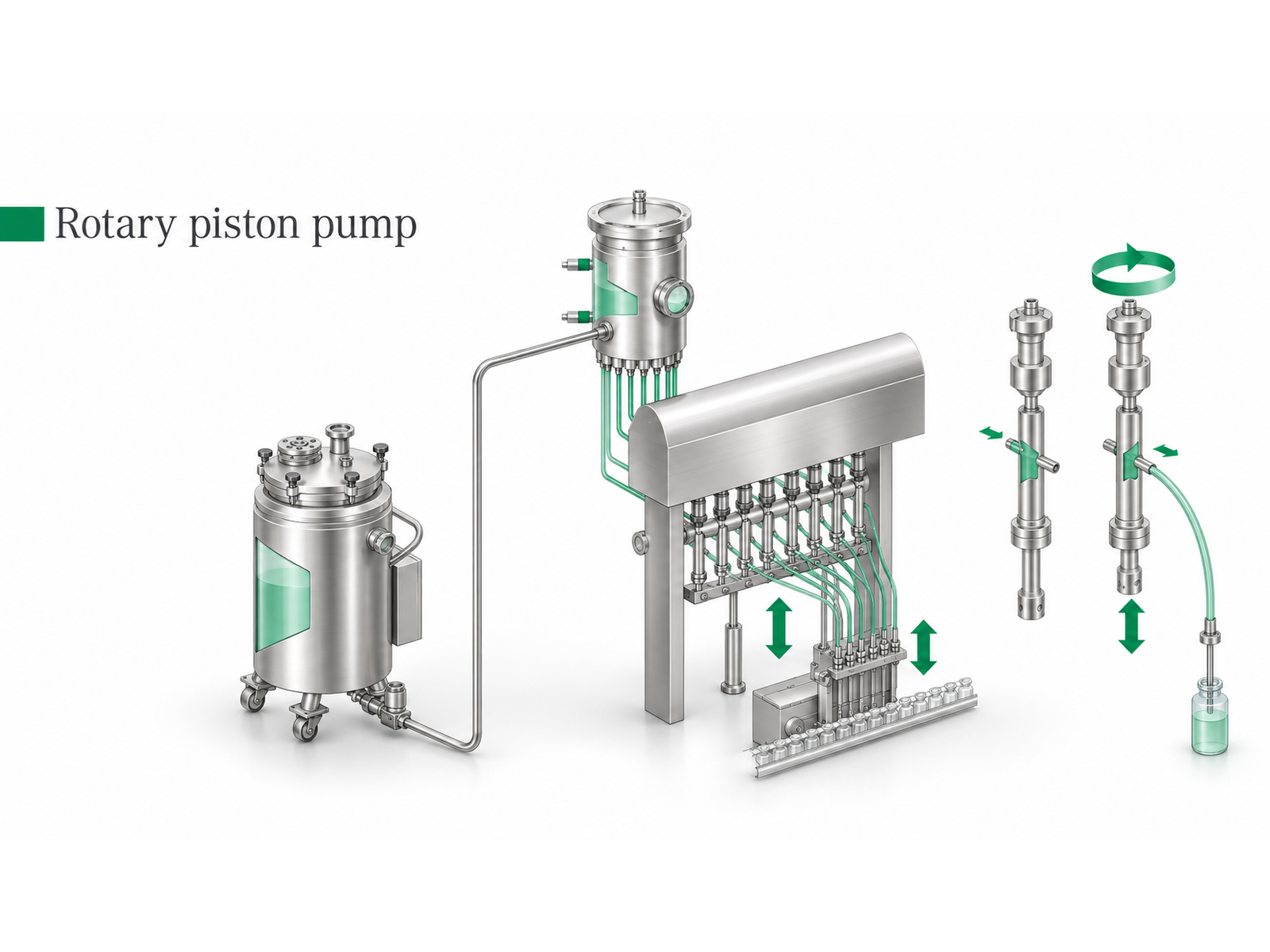
Piston pump

A piston draws liquid into a cylinder and then dispenses a measured volume through the outlet. The selected piston, valve and product-contact materials determine the application range. Review viscosity, cleaning requirements and the required filling volume together with the product and container format.

Explore technology
Rotary piston metering equipment connected to a set of filling heads

Filling technology

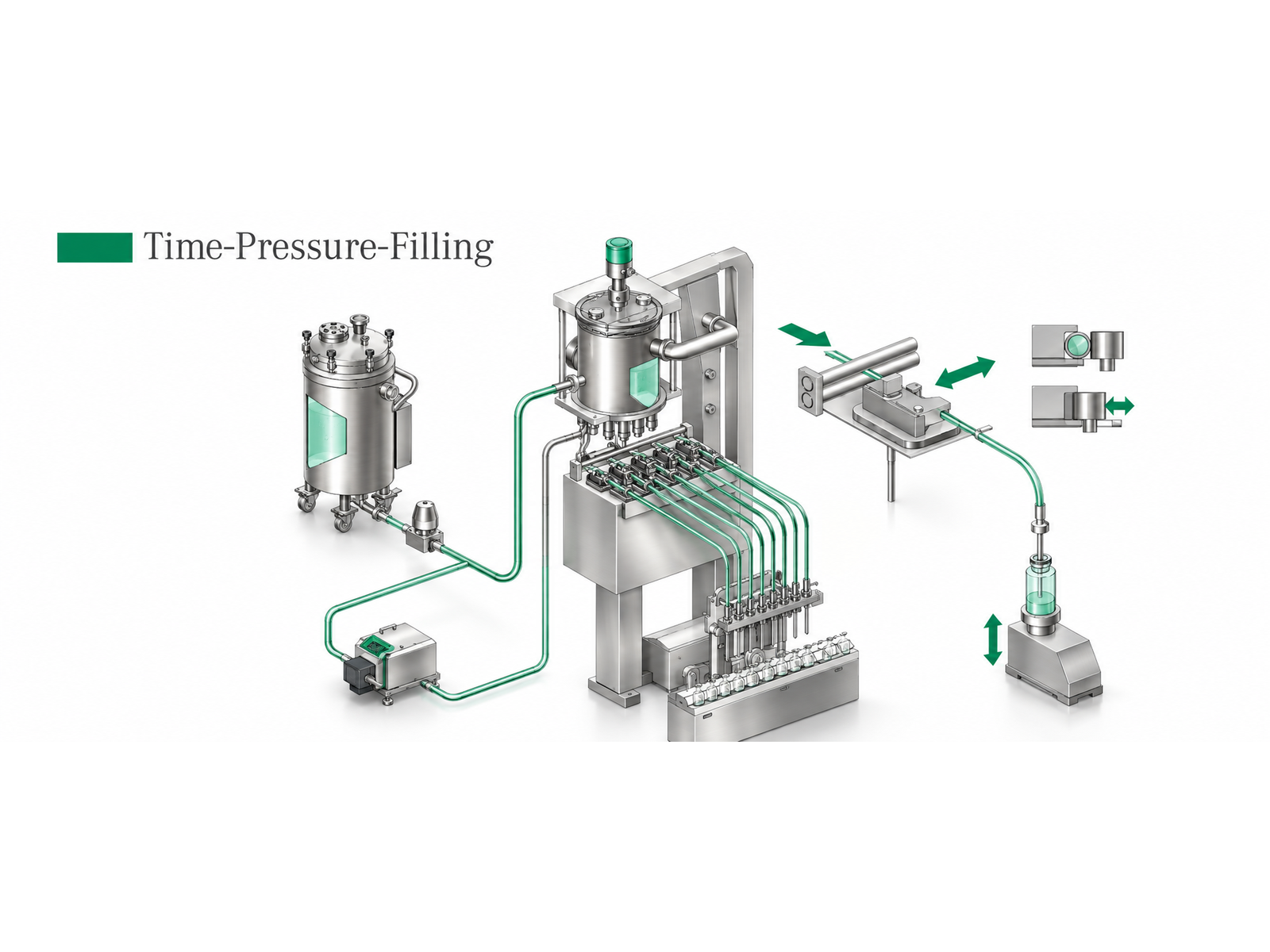
Time pressure

Controlled pressure moves liquid through a filling valve. The opening time and supply conditions determine the dispensed quantity. Product properties, pressure stability and the valve configuration are evaluated together when setting up the filling process.

Explore technology
Diagram of a time-pressure dosing vessel and filling heads

Filling technology

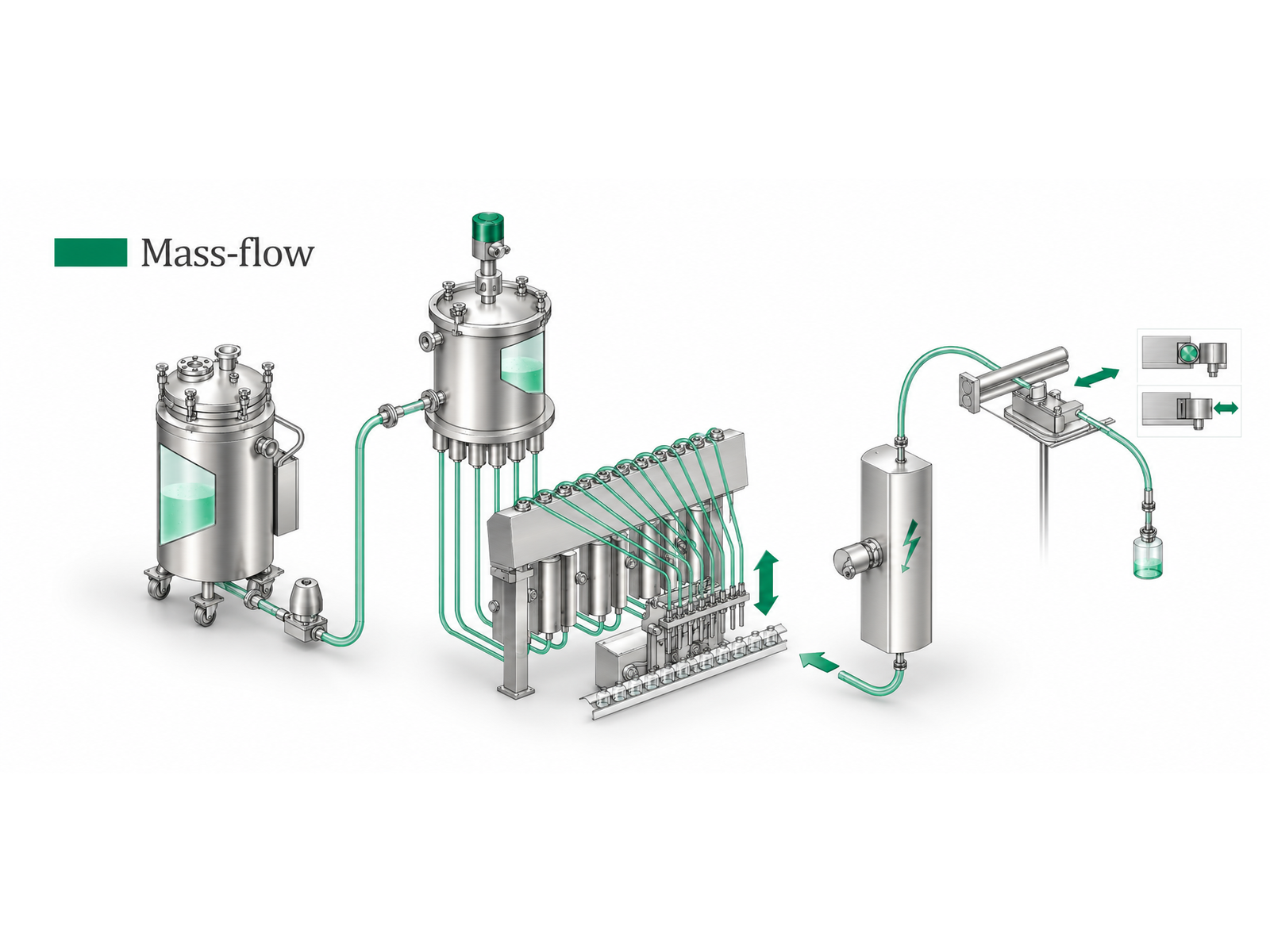
Mass flow

A flow sensor measures the product passing through the filling path and provides feedback to the dosing valve. The process is evaluated around the required fill mass, product behaviour and cleaning strategy. Sensor selection and the control sequence depend on the application.

Explore technology
Product flow path with a mass flow meter and dispensing points

Filling technology

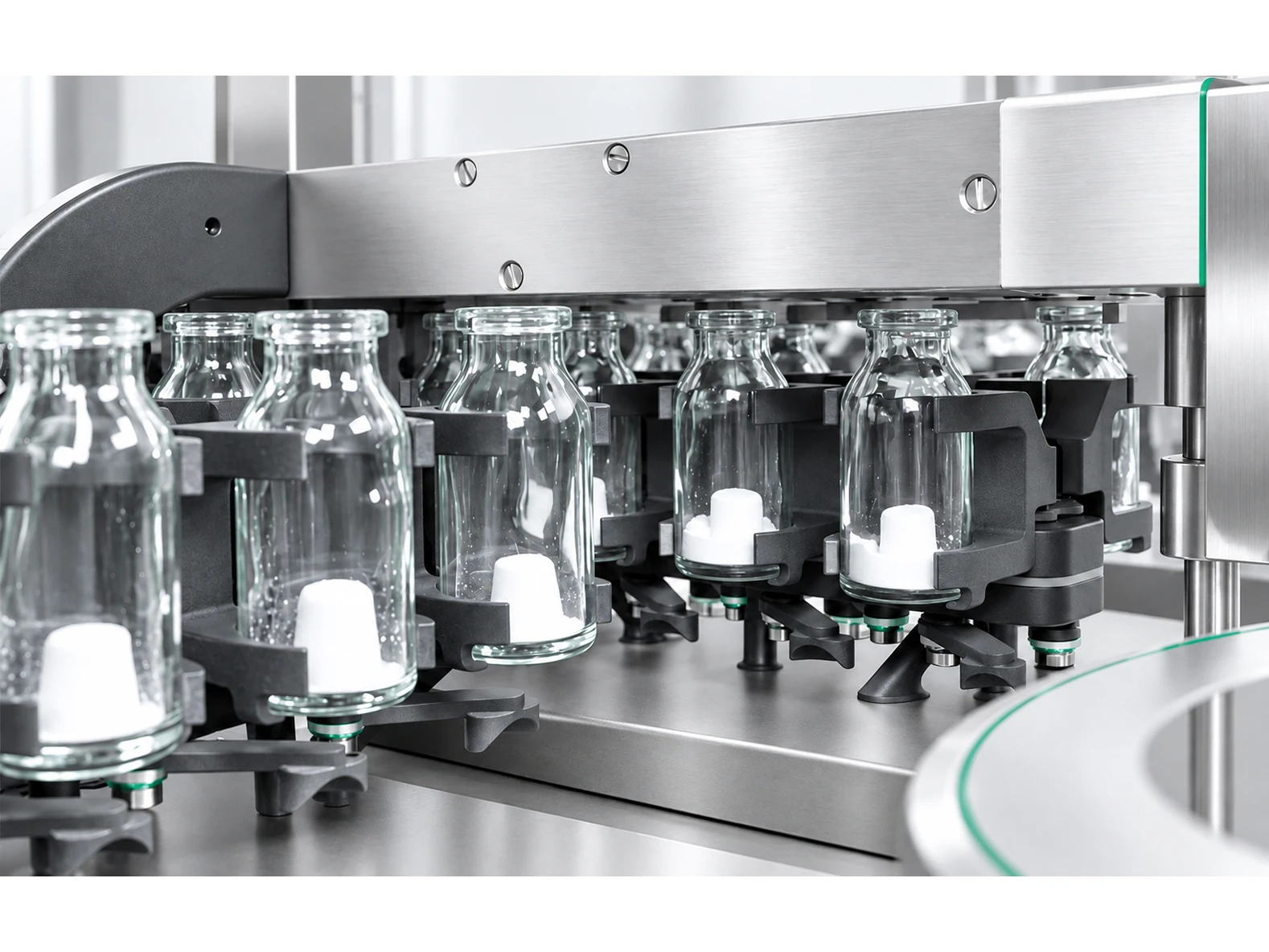
Powder filling

Powder is metered using an auger or a vacuum-based dosing system, depending on the selected configuration. Flow behaviour, bulk density, dose size and containment requirements guide the equipment discussion. The powder and container should be evaluated together during process development.

Explore technology
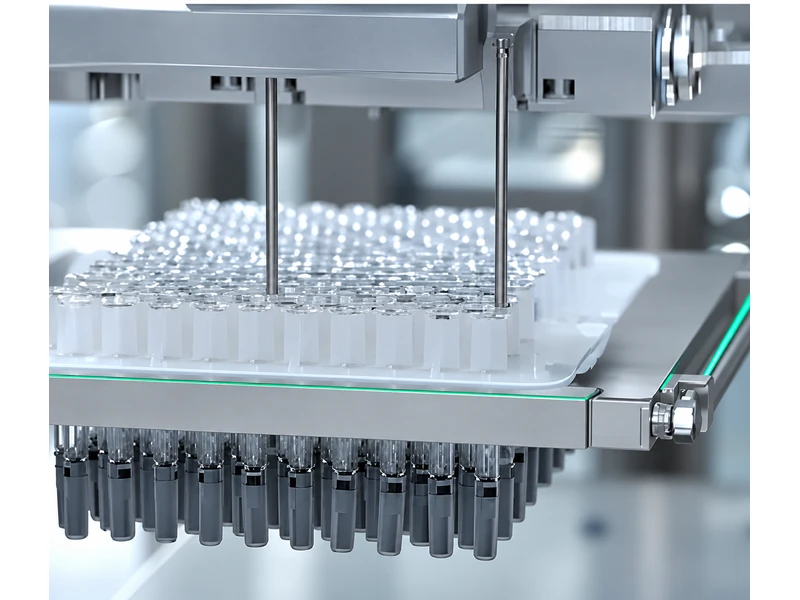
Glass vials presented below the powder dispensing heads
Dosing principle illustration · configuration depends on the application.
Technology 1 of 5

Peristaltic pump

Diagram connecting a peristaltic pump to the product filling path

Peristaltic Pump

The peristaltic pump moves product by squeezing a flexible tube — the product never contacts the pump mechanism, only the hose. This makes it exceptionally gentle on shear-sensitive biologic products, blood plasma, vaccines, and cell therapies, where shear forces can degrade proteins or cell viability. Cross-contamination risk is minimized because the wetted path is a single disposable tube, and changeover is fast — ideal for multi-product CDMO environments. Accuracy is typically ±1 %.

Piston pump

Diagram connecting a peristaltic pump to the product filling path

Piston Pump (Rotary Valve Piston Pump)

The piston pump is a volumetric dosing device: a cylinder draws product in on the suction stroke and expels it on the discharge stroke through a rotary valve. It delivers highly repeatable fill volumes across aqueous and viscous products, does not require IPC correction, and is robust enough for 24/7 production. A stainless-steel version is standard; a ceramic version is available for abrasive or hot products.

Time pressure

Diagram connecting a peristaltic pump to the product filling path

Time-Pressure Filling

Time-pressure filling uses compressed gas to push product through a precision nozzle. Fill volume is determined by how long the nozzle stays open and how much pressure is applied. It has no moving parts in product contact, making it easy to clean and suitable for sterile applications. It is best for low-to-medium viscosity aqueous products, with typical accuracy of ±0.5–1.0 %.

Mass flow

Diagram connecting a peristaltic pump to the product filling path

Mass-Flow Filling

Mass-flow filling uses a Coriolis sensor in the product line to measure the actual mass of product dispensed in real time. The dosing valve closes when the target mass is reached, regardless of viscosity, temperature, or density changes. It is highly accurate, self-regulating, and requires no IPC scale to correct drift — ideal for high-value products where every drop matters.

Powder filling

Diagram connecting a peristaltic pump to the product filling path

Powder Filling

Powder filling dispenses solid drug powder directly into vials or cartridges using either an auger screw or a vacuum-based system. Auger fillers measure volume by the number of screw rotations; vacuum systems pull powder into a dosing chamber by air pressure difference. Both achieve accuracy of ±1–2 % on powder weight.

Variofill

Diagram connecting a peristaltic pump to the product filling path

Variofill (Modular Pump Platform)

Variofill is the interchangeable dosing platform that accepts three pump technologies on the same filling base — rotary piston pump, peristaltic pump, and time-pressure valve. A single station can switch between pump types via recipe changeover, making it ideal for CDMOs and multi-product manufacturers who run small molecules, biologics, and vaccines on one line without dedicated machines.

Restoperring

Diagram connecting a peristaltic pump to the product filling path

Restoppering

Restoppering is a recovery function built into the stoppering station: if the first stopper insertion fails — for example, a stopper is not seated — the machine does not immediately reject the vial. Instead, it automatically retries the insertion cycle, re-seating the stopper before the vial advances. This reduces waste from avoidable stoppering errors, particularly in high-speed lines where stopper feeding jams are the most common reject cause.

Smart-filling

Diagram connecting a peristaltic pump to the product filling path

SmartFill — Zero Product-Loss Filling System

SmartFill is a comprehensive product-loss reduction platform that eliminates waste across the entire filling cycle — from start-up through production to shutdown. It operates in three phases:

1. Start-up without product loss. The system performs loss-free bleeding of all hoses, then runs the first few containers on scales and self-optimizes each filling position before production begins — so no vials are scrapped during initial setup.

2. Production without product loss. During running production, SmartFill maintains 100 % in-process control with continuous self-optimization. If production stops and restarts, the system resumes automatically without re-baselining. Underfilled vials are topped up on the scales in real time instead of being rejected.

3. Running empty with minimal loss. At batch end, the system can either empty all filling positions simultaneously or sequentially, using the scales to dispense residual product accurately rather than wasting it as purge.

The result: near-zero product loss across start-up, production, and shutdown — a direct cost saving on every batch of high-value biologic or sterile product.

Process challenges

1.Dont know how to choose the right filling technology?

Read details

1.Dont know how to choose the right filling technology?

2.Filling accuracy is not ensured.

3.Shearing force creats protein aggregation

Technical data & features

Use these inputs to define the proposed configuration. Confirm operating values against the selected model and trial conditions.

Selection inputs for Filling Pump
Project input What to record and why
Container drawing Provide the controlled drawing and tolerances for support, guidance, filling and closing. Nominal container volume alone is insufficient to specify tooling.
Product-contact materials Identify wetted parts, seals and disposable components in the proposed path. Review compatibility with the product and the chosen cleaning approach.
Intended dose Give the target dose, allowed variation and how it will be measured. Identify any permitted overfill separately.
Closure format Provide the closure drawing, delivery condition and engagement method. Identify how seating, sealing or torque will be verified.
Batch size State the smallest and largest intended lot, with units, plus any allowance for priming and samples. This separates preparation need from machine rate.

How it works

How does the dosing principle affect product contact?

The metering system defines the product-contact path between preparation and the filling needle.

How do we compare pump trials with the same product?

Characterise startup, interruptions and restart with the selected tubing or metering components.

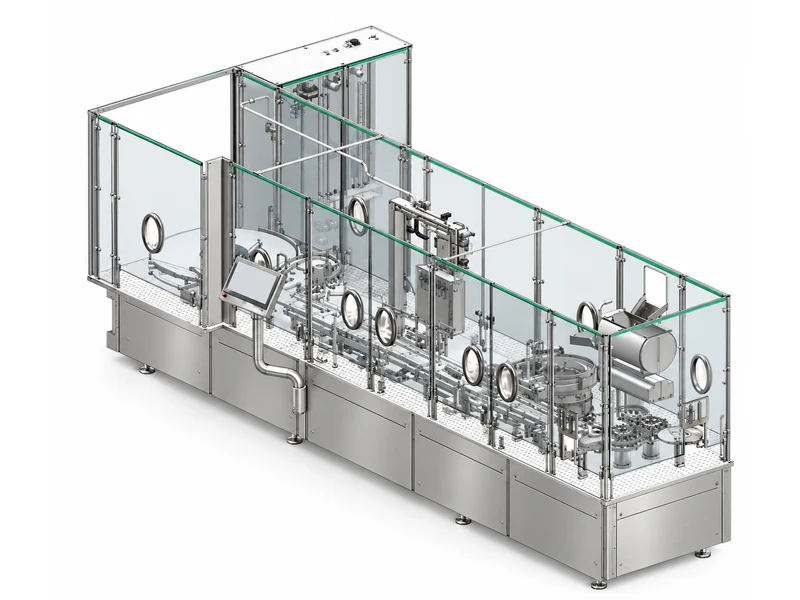
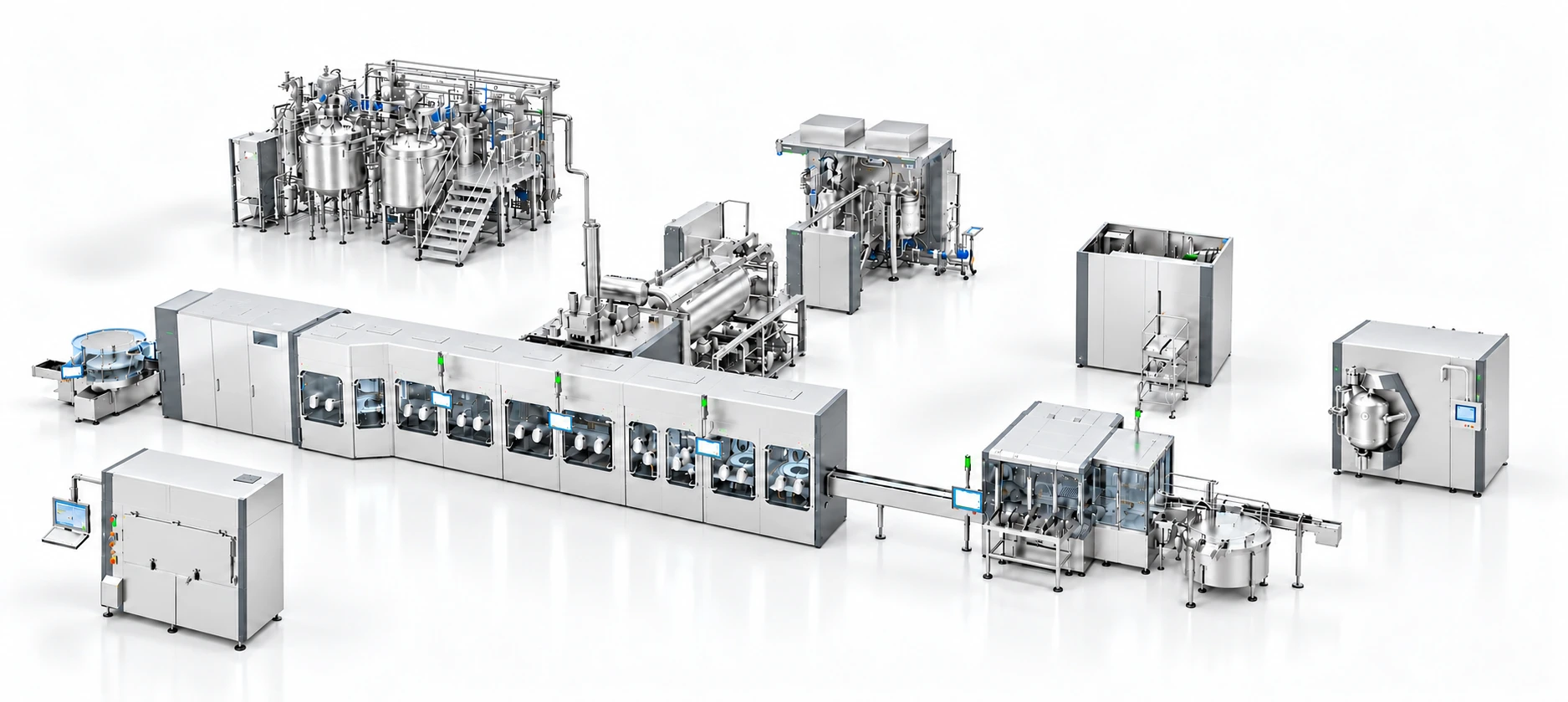
Liquid vial preparation and filling. Follow the preparation, washing, tunnel and vial filling stations. The separate drying equipment serves lyophilized presentations. The line provides process context; the individual product is not identified as a separate station in this view.

Production line · Equipment context

Liquid vial preparation and filling

Explore the process areas on the production line associated with this equipment.

Skip tour
Selected process route 8 equipment areas · Scroll to explore

Follow the preparation, washing, tunnel and vial filling stations. The separate drying equipment serves lyophilized presentations. The line provides process context; the individual product is not identified as a separate station in this view.

Related production lines: Liquid Vial Filling & Packaging Lines · Antibody-Drug Conjugate Manufacturing & Fill-Finish · GLP-1 Filling & Drug-Delivery Equipment · Plasma-Derived Product Preparation & Fill-Finish · Vaccine Formulation & Fill-Finish Equipment · Lyophilized Vial Production Lines · Nasal Spray Filling & Assembly Lines · Soft Mist Inhaler Filling & Assembly Lines

Line integration

The metering system defines the product-contact path between preparation and the filling needle.

Characterise startup, interruptions and restart with the selected tubing or metering components.

Diagram connecting a peristaltic pump to the product filling path

Support throughout your project and production

Define the equipment scope

Tubing compatibility, viscosity, dose size and the cleaning strategy distinguish peristaltic, piston, time-pressure and flow-metered dosing.

Learn more

Agree the acceptance test

Characterise startup, interruptions and restart with the selected tubing or metering components.

Learn more

Prepare for operation

Identify the contact parts and format tooling for Filling Pump. Agree access for cleaning, the spares to hold and the operating records the site will need.

Learn more

Knowledge hub

2 resources

Frequently asked questions

Q1: What factors should I consider when selecting a filling pump?

A: Key factors include: fluid characteristics (viscosity, shear sensitivity, foaming tendency), required accuracy (±0.5% to ±2%), production speed, sterility requirements, product value, and changeover frequency. Understanding these will narrow your options quickly.

Q2: When should I choose a peristaltic pump?

A: Choose a peristaltic pump when handling shear-sensitive fluids like vaccines, cells, or proteins. It is also ideal for multi-product CDMO facilities because the fluid contacts only disposable tubing, eliminating cross-contamination and cleaning validation.

Q3: When is a piston pump the better choice?

A: Piston pumps are best for high-precision, high-speed production requiring excellent repeatability. They are robust enough for 24/7 operation and suitable for abrasive or hot products when equipped with ceramic valves. However, they require CIP/SIP and are not ideal for shear-sensitive biologics.

Q4: What are the advantages of time-pressure filling?

A: Time-pressure filling has no moving parts in contact with the product, making it simple, clean, and easy to maintain. It works well for low-to-medium viscosity aqueous solutions with good accuracy (±0.5–1.0%). It is less suitable for high-viscosity or shear-sensitive fluids.

Q5: When should I use mass flow filling?

A: Mass flow filling is ideal for high-value products where every drop matters. Using a Coriolis sensor, it measures actual mass in real time, independent of temperature, density, or viscosity changes. No density correction is needed.

Q6: Can I use one pump for both R&D and production?

A: Yes. Modular platforms like Varifill allow you to switch between peristaltic, piston, and time-pressure technologies on the same base. This provides flexibility from clinical trials to commercial production without dedicated machines.

Q7: How do I minimize product waste during filling?

A: Consider a SmartFill system. It eliminates waste during startup (auto-calibration without scrapping bottles), running (real-time top-up instead of rejection), and shutdown (accurate residual emptying). This directly reduces cost per batch for high-value biologics.

Q8: What accuracy can I expect from each pump type?

A:

Peristaltic: ±1%

Piston: ±0.5% or better

Time-Pressure: ±0.5–1.0%

Mass Flow: High accuracy based on mass, no density correction needed

Powder: ±1–2% by weight

Q9: How do I handle stopper insertion errors?

A: Use a Restoppering function. Instead of rejecting the vial, the system retrieves the stopper, re-seals it, and retries the insertion cycle. This reduces yield loss and avoids unnecessary downtime.

Q10: What if my product is shear-sensitive?

A: Avoid piston pumps. Choose peristaltic pumps with low-shear tubing, or time-pressure systems with no moving parts. Both minimize shear stress and prevent aggregation or cell damage.

Contact

For a configuration review, include container drawing, product-contact materials, intended dose, closure format, batch size.

Discuss your project
Diagram connecting a peristaltic pump to the product filling path